
The process of settling in is a milestone in a family’s life, one that brings many new experiences for children. During this period, you as parents/caregivers also go through a kind of “settling” process. It is completely natural and understandable if, in this new situation, not only your child but you as well feel a bit uncertain sometimes, as we often happen to be the second social environment for your child after the family.
We have written about the process and conditions of settling in previously—you may also find it useful to read this article on our website. However, as several children are now starting the settling process with us again, we would like to revisit the most important aspects. While we will briefly touch on the framework, the main aim of the following summary is to help you understand how you, as parents or caregivers, can most effectively support the process when you are already present with us in the Meseerdő room.

Preparing for separation
Children often experience for the first time with us that the people most important to them say goodbye to them and pass out of their view. The feeling of absence can naturally trigger their anxiety, but with conscious attention, separation can be made easier. It helps if you also make sure at home not to leave them without saying goodbye. It is also very helpful for them to discuss and explain in advance where you are going and when you will return. Upon reunion, it is beneficial to express your joy of seeing them again and talk over what has happened during the time apart.
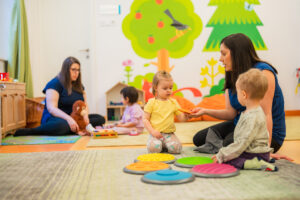
At Meseerdő, we also try to achive a progressive transition: at first, you say goodbye only for a short amount of time so that your child can experience that you always return to them. In our experience, the whole process is also greatly supported if the child is already familiar with the Belvárosi Közösségi Tér—for example, previous visits to the Hetedhét playroom or participation in other activities that the community offers can provide a more stable emotional foundation for starting the settling.
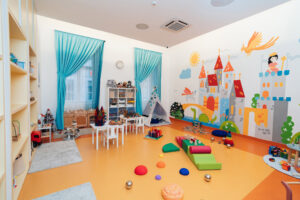
The principles and framework of settling
Children can be accompanied by anyone close to them (parent, grandparent, caregiver) buti t is important to note that only one adult may be present in the room at a time. During the first three occasions – preferably on three consecutive days – you will also be present in the room for one hour each time, staying in the background. The main goal is to achive that your child’s attention gradually shift toward us. The further schedule is always tailored to individual needs, and we provide detailed feedback at the end of the third session.
Great timing is also key to a successful settling: it is most favorable to choose a time when you can ensure consistent participation over the following 3–4 weeks. The process can easily be disrupted if a planned trip or longer absence interrupts the developing attachment. Therefore, we recommend starting settling at a time when you can be continuously present in this new phase of your child’s life.
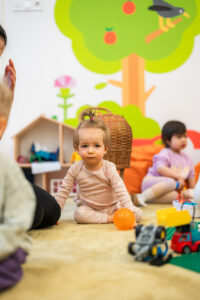


Parental presence in the Meseerdő room
One of the most common question we get asked is how to behave while staying in the room. Should I be actively involved or rather withdraw? Should I play with my child or try to remain unnoticed?
- Based on our experiences the role of a “secure base” is the most effective: be present, but remain a passive observer. It is best to sit somewhere along the wall, on the floor, where you do not interfere with their free play—this also allows us to move freely within the room.
- If your child comes up to you, do not ignore them: briefly hug them, give them a kiss, “recharge” them with a little affection, then gently encourage them to return to play. If they are not yet able to separate from you, of course you may play together, and we will gradually become involved in your play as well. As soon as you notice that your child is beginning to relax and engage more deeply in play, it is worth slowly withdrawing. This kind of “invisible” presence supports them the most.
- Please do not use your phone while you are in the room. This is not only because the device attracts the attention of other children, but also because it disrupts the connection with your own child. During the settling, your child will frequently “check back” with you from a distance, seeking your gaze and your smile for reassurance that everything is okay. If you are absorbed in your phone, they lose this emotional connection and may feel the need to come back to you physically to get your attention. This interrupts their play, their connection with us, and the overall flow of the process. A simple reassuring smile, however, can calm them from a distance and encourage them to return to play more confidently without needing to come back into your arms.
- We also kindly ask that – although it may be tempting – you do not engage in play with the other children in the room. If you start playing with them, it may trigger jealousy in your own child, who will immediately seek your attention. Additionally, you may form connections with other children that could leave them feeling a sense of loss when you eventually leave the room.
- Please gradually allow us to take over caregiving tasks (for example, offering drinks) and managing any conflicts that arise. It is important that your child learns to accept guidance from us as well, as we set the directions and rules in this environment. If you provide guidance in play or interactions, it may unintentionally make it harder for your child to accept our help or requests. If you allow us to respond to situations, your child will learn that they can confidently turn to us for help, and a trusting relationship will develop – this is essential for a successful settling.
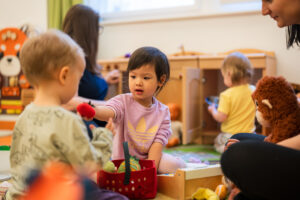
As a parent, it is a significant milestone to place your trust in others to care for what is most precious to you. Taking time to prepare yourself emotionally for these moments can help you feel more ready for the separation and better able to support your child through it.
We believe that with our professional guidance and your supportive presence, joining a community will become a positive and meaningful experience for your child and you as well.